
The Morrígan’s Game
Finding Celtic Gods in Modern Cork
6 December 2025 ~ 3 min read
The Celtic gods never left Ireland. That’s not a line from the book—that’s the conviction I started writing from. They’re in the stone circles and the thin places, in the crow on the fence post that watches you a beat too long, in the way a fog rolls into Cork like it has somewhere specific to be. When I sat down to write The Morrígan’s Game, the question was never “what if the old gods were real?” It was: “what if they’ve been here the whole time, and we just stopped paying attention?”
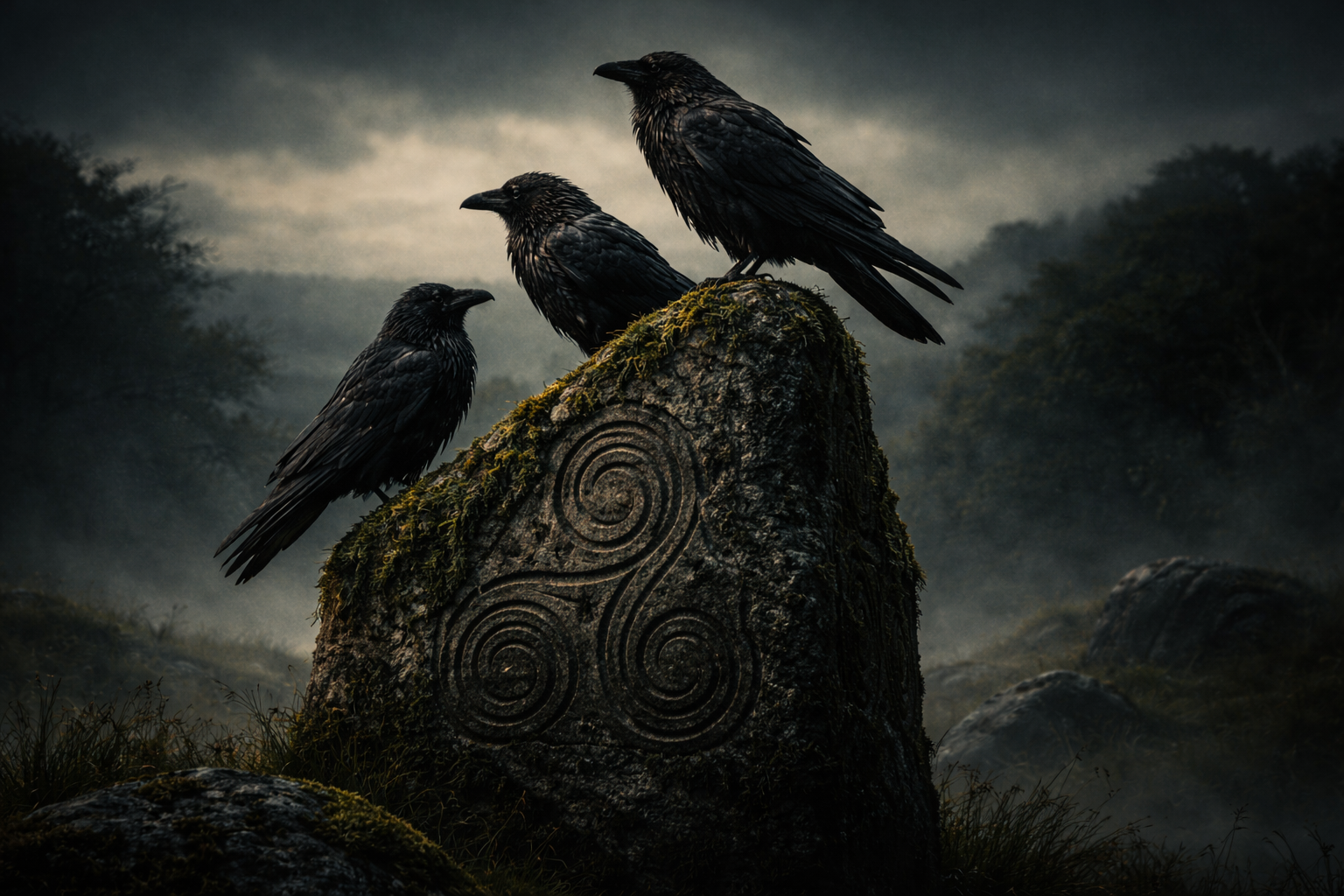
Of all the figures in Irish mythology, the Morrígan is the one I couldn’t stop thinking about. And I think it’s because she refuses to be one thing. She’s a war goddess, yes—but she’s also a shape-shifter, a prophet, a sovereignty figure, a crow circling the battlefield, and a woman washing bloodied armor at the ford. The old texts give her at least three faces: Badb, Macha, and the Morrígan herself, sometimes overlapping, sometimes contradicting each other. She’s not evil. She’s not good. She’s necessary. She’s the part of existence that says: conflict isn’t something to be cured. It’s something to be understood.
That’s what made her the perfect antagonist—or teacher, or test, depending on how you look at it—for Seán O’Sullivan. In An Apology to the Cosmos (Book One), Seán learns to transform conflict into harmony. He’s good at it. Maybe too good. So in Book Two, the Morrígan wakes up after three thousand years, thoroughly annoyed that someone is turning all her beautiful conflicts into “lullabies.” She doesn’t arrive to destroy him. She arrives to ask a question: what happens when you meet a problem that harmony can’t solve?
Writing her was the most challenging and rewarding part of the process. I didn’t want a villain in a dark cloak. I wanted the goddess from the manuscripts—ancient, shape-shifting, unsettling, and right about half the things she says. She walks into a music session at Tigh Ceoil (House of Music, pub) and criticizes the music for lacking “conviction” and “blood.” She gifts Seán a bone flute carved from her own raven’s wing that forces anyone nearby to tell the truth. She’s terrifying not because she’s cruel, but because she sees clearly and doesn’t flinch.
The deeper I went into the research, the more I fell in love with how Irish mythology handles its gods. They’re not up on Olympus hurling thunderbolts. They’re here. They’re the quizmaster at your local pub who happens to be Ogma, god of eloquence, quietly strengthening communal bonds one trivia question at a time. They’re the three ravens watching from the rooftop with unnatural patience. The mythology doesn’t separate the sacred from the ordinary—it insists they’re the same thing. That’s what I wanted on the page: gods who feel like Cork, not like special effects.
The Morrígan’s lesson—her real lesson, underneath all the chaos she unleashes—is that loss shapes us more than victory, and that true love knows when to let go. It’s not a comfortable truth. It wasn’t comfortable to write. But it felt honest, and it felt Irish, and honestly, it felt like something she’d approve of.
I suspect she’s still watching. Probably from a fence post somewhere outside Cork.
~ Liam