
The Same Ear
Why a Composer Wrote Two Novels That Sound Nothing Alike
8 March 2026 ~ 3 min read
People ask me how I ended up writing both a literary historical novel set in 1830s Paris and a cosmic fantasy trilogy set in Cork. The short answer is: I didn’t plan to. The longer answer is that both books come from the same place—a composer’s ear that can’t stop listening for what isn’t being said.
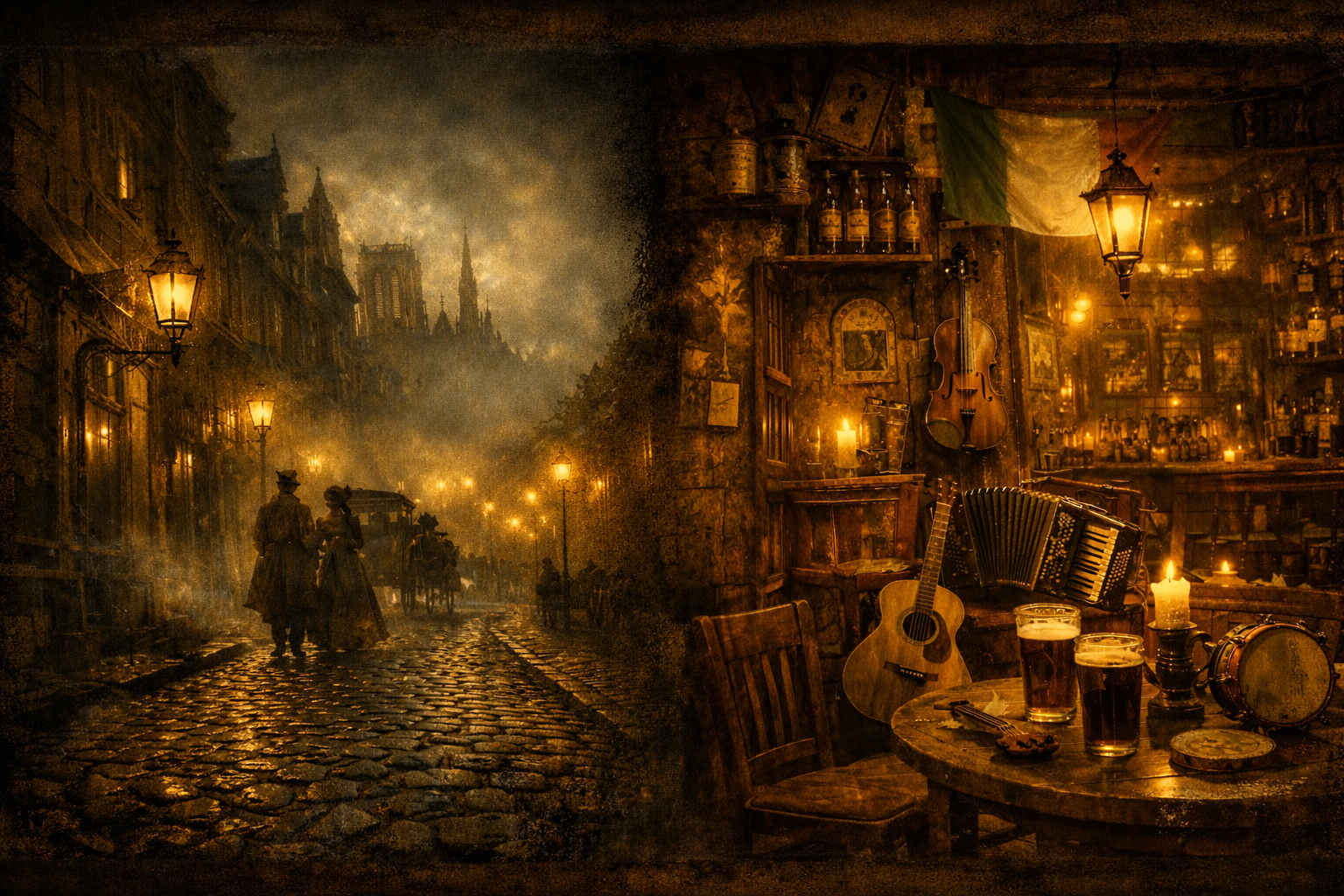
The Year of Shadows began with Berlioz. I’d spent years listening to the Symphonie Fantastique, years teaching it, years hearing things inside the music that I couldn’t find in any biography or program note. Then I realized that Edgar Allan Poe—the inventor of the detective story, the architect of American darkness—was alive in 1830 and could have been in Paris when Berlioz premiered the most radical symphony in history. They never met. But they should have. Two outsiders, two obsessives, both turning personal anguish into art that would outlast them by centuries. The novel wrote itself the moment I put them in the same room.
The Cosmic Janitor Trilogy began with Cork. I was in the back of a taxi with a driver named Pat Winning, heading out to the Midleton Distillery, and the man talked the whole way—stories, history, opinions, the real craic. That particular Cork music, the rise and fall of the accent, the way a sentence can start as an insult and land as a blessing. And I thought: this city is too strange to be one place. What if it were seventeen? What if every version of Cork that ever existed—Viking Cork, Butter Cork, Passive-Aggressive Cork—were all real, all layered on top of each other, and the only person keeping them from flying apart was a janitor with a mop and a bone flute? The trilogy wrote itself the moment I heard the Morrígan laugh.
On the surface, these two projects have nothing in common. One is grounded in historical research, primary sources, and the real streets of 1830 Paris. The other fractures a single Irish city into seventeen dimensions and sends the Devil to a wellness spa. One uses Poe’s cadences. The other uses Cork slang. One ends in a graveyard. The other ends in a pub quiz.
But a composer hears the shared key beneath two different pieces, even when the tempo and instrumentation are nothing alike. And the shared key here is this: both books are about artists who hear things that other people don’t—and what happens when the thing they hear is too large, too dangerous, or too beautiful to keep to themselves.
Berlioz heard a symphony inside his obsession with Henriette Smithson. Poe heard detective fiction inside the darkness of his own mind. Seán, the cosmic janitor, hears the fabric of reality fraying every time he plays the bone flute. In all three cases, the hearing comes first. The art—the symphony, the story, the music that holds the universe together—is what happens when someone refuses to stop listening.
That’s why I wrote both books. Not because I wanted range, or because I couldn’t choose a genre, but because both stories asked the same question: what does it cost to hear what others can’t? In Paris, the cost is Berlioz’s sanity, Poe’s reputation, and a woman’s life. In Cork, the cost is seventeen dimensions, a deal with the Devil, and a janitor who has to choose between the woman he loves and the cosmos he’s sworn to maintain. Different stakes. Different centuries. Same ear.
I’m a composer. I spent years writing music before I wrote a word of prose. That training didn’t give me a style—it gave me a way of hearing stories before I see them. When I listen to the Symphonie Fantastique, I hear a novel. When I listen to a Cork pub session, I hear a trilogy. Both sounds were always there. I just needed enough silence to notice them.
Two books. Two worlds. One ear. If you’ve read this far, I suspect you have that kind of ear too.
~ Liam