
The Composer’s Ear
How Writing Music Changed the Way I Write Prose
1 February 2026 ~ 3 min read
Before I wrote novels, I wrote music. Orchestral pieces, chamber works, a composition for flutes and percussion that accompanied Native American stories, a piece called Odusseia that a pianist once took a train from Salzburg to Padova at her own expense to perform again. I spent years learning how sound moves through time—how a melody builds tension, how a rest can hit harder than a note, how the silence after a climax is where the audience actually feels what just happened.
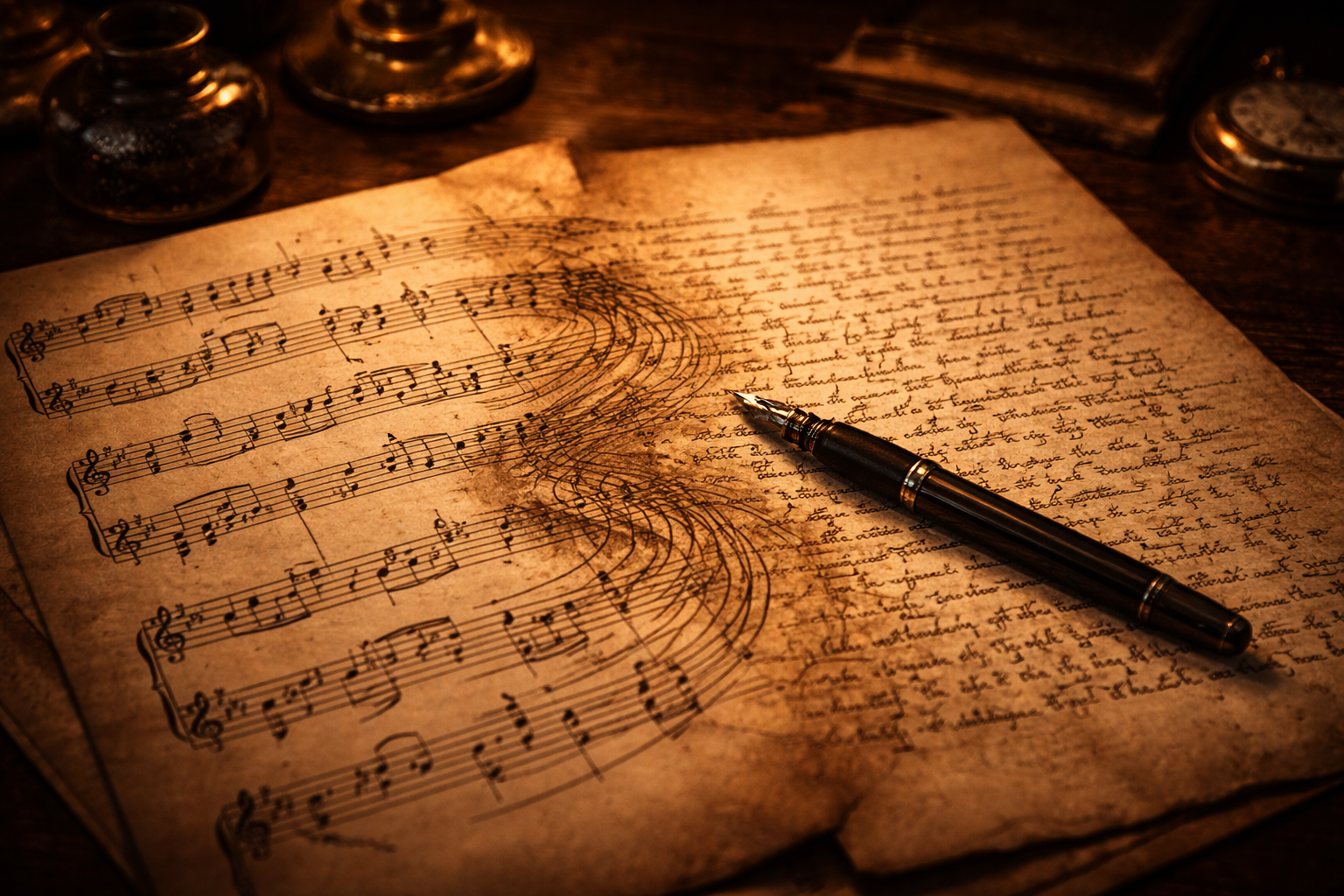
I didn’t realize how deeply that training had shaped my prose until someone pointed it out. A reader told me my sentences had rhythm—not in the obvious, poetic sense, but structurally. Short sentences after long ones. Fragments after flowing paragraphs. A scene that builds in long, compound phrases and then lands on something blunt. That’s not a writing technique I learned from a craft book. That’s phrasing. That’s what musicians do.
Composers think in terms of tension and release. A dissonance wants to resolve. A held note wants to move. An accelerating rhythm wants to arrive somewhere. When I’m writing a scene, I’m not thinking about word count or paragraph length—I’m listening for the shape of the tension. Does this chapter build too fast? Does this dialogue need a rest before the next exchange? Is this climax landing, or does the reader need a measure of silence before it hits? The vocabulary is musical, and I can’t turn it off.
Rests are the thing most writers underestimate. In music, a rest isn’t absence—it’s a deliberate, composed silence that gives meaning to the notes around it. Beethoven understood this. So did Miles Davis, who said music is the space between the notes. In prose, the equivalent is the scene break, the paragraph of white space, the moment where a character stops talking and the reader is left holding the weight of what was just said. I use those silences the way I’d use a fermata—not because I’ve run out of words, but because the silence is the point.
Orchestration matters too. A composer learns to balance voices—when the strings carry the melody, the brass must recede. When the timpani enters, everything else adjusts. Writing multiple characters in a scene is the same problem. Whose voice leads? Whose voice provides harmony? Whose voice is the percussion—the sharp, rhythmic interruption that changes the texture of the conversation? In The Year of Shadows, Edgar is the lead melody—precise, dark, always moving. Hector is the brass—bold, sometimes too loud, impossible to ignore. Eleanor and Henriette are the countermelodies—independent, equal, weaving through both of them without ever losing their own line.
I hear my novels before I see them. The opening of The Year of Shadows—“The man gripping the ship’s railing was no one yet”—has the rhythm of a single sustained note, a held breath before the melody begins. The Trilogy’s Hell chapters are scored in a completely different key—faster, louder, syncopated, comic. When Seán plays the bone flute, I’m writing the scene in the flute’s register: thin, haunting, exposed.
Being a composer didn’t make me a better writer. It made me a different kind of writer—one who thinks in sound, paces in measures, and knows that the most powerful moment in any piece of music is the rest that follows the final note. The silence where the audience decides what they felt. I try to end every chapter the same way: with a silence worth holding.
— Liam