
Why a Composer Wrote a Novel About a Song
On Melizma, a Lifetime of Listening, and the Book I Was Always Going to WRite
26 July 2026 ~ 4 min read
Before I wrote novels, I wrote music. Art songs, opera, choral works — and for as long as I can remember, I have been listening to a single sound.
It has a technical name: melisma. It is what happens when a singer takes one syllable and, instead of moving on, holds it and runs it up and down across many notes — the voice bending, curling, refusing to resolve. You have heard it without knowing its name. It is the long ache in a Gospel run, the turn in a flamenco cante, the wail of a sean-nós singer in Irish, the cantor’s line in a synagogue, the muezzin’s call. Different faiths, different continents, different centuries — and underneath them, again and again, the same gesture: the voice leaving words behind.
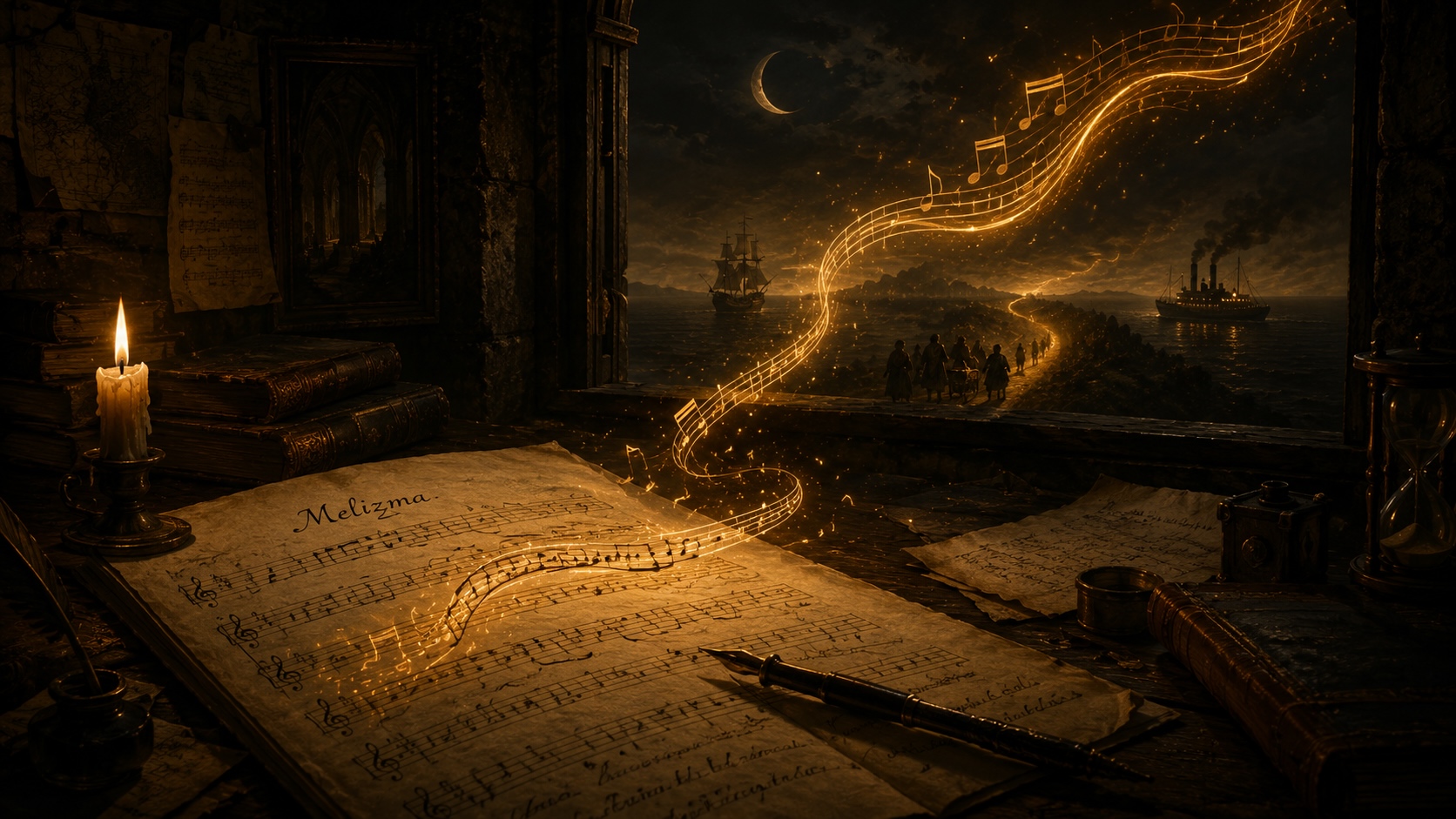
I have spent my working life with that sound, as a composer who makes it and a teacher who tries to explain it. And somewhere along the way a question lodged in me that music alone could not answer. Why does it sound the same everywhere? Why does grief, in every tradition I have ever studied, reach for the same wordless shape? It is as if the melisma were older than any of the musics that use it — as if it came from somewhere before Spain or Ireland or Sicily, and each culture only gave it a local accent.
A composer can write that sound. I have. What a composer cannot do is follow it. A piece of music happens once, in one room, in one language of style. But the question I had was a question about time — about a sound moving through centuries and across borders, surfacing in one throat and then, generations later, in another. That is not a question you can score. It is a question you can only tell. And to tell it, I needed people: a boy in the Spain of 1492, a woman driven out of Granada, a keener in the Irish Famine, a man on a ship to Ellis Island, and a woman alive today. I needed a novel.
So I wrote one. It is called Melizma — my own spelling of the word, because the book is named for the thing itself: the wordless run of the human voice. In it, a single melismatic phrase surfaces across five centuries of exile, carried each time by someone who does not know they are carrying it, until it reaches a woman in the present who weeps at a stranger’s funeral and cannot say why.
People sometimes ask how much research a book like this took — how long I spent learning the vocal traditions at its heart. The honest answer is that I did not research my way into this novel. I was already there. The Sephardic cantillation, the Irish keen, the Griko song, the melisma of grief — these are not subjects I studied for the book. They are the music I have spent my life studying and making. The novel is not a departure from that life. It is the same life, finally written down in prose.
I used to think I had two vocations, music and fiction, that happened to live in the same person. I do not think that anymore. They are the same vocation. Both are just me, listening for the sound underneath the words, and trying to pass it on.
I spent a career learning to make the sound. It took a novel to follow it home and that took 4 years.
~ Liam