
5 December 1830
The Night the Symphonie Fantastique Changed Everything
28 June 2026 ~ 3 min read
The Year of Shadows builds toward a single night: 5 December 1830. That’s the date Hector Berlioz premiered the Symphonie Fantastique in Paris. It really happened. And what happened that night was as dramatic as anything in the novel.
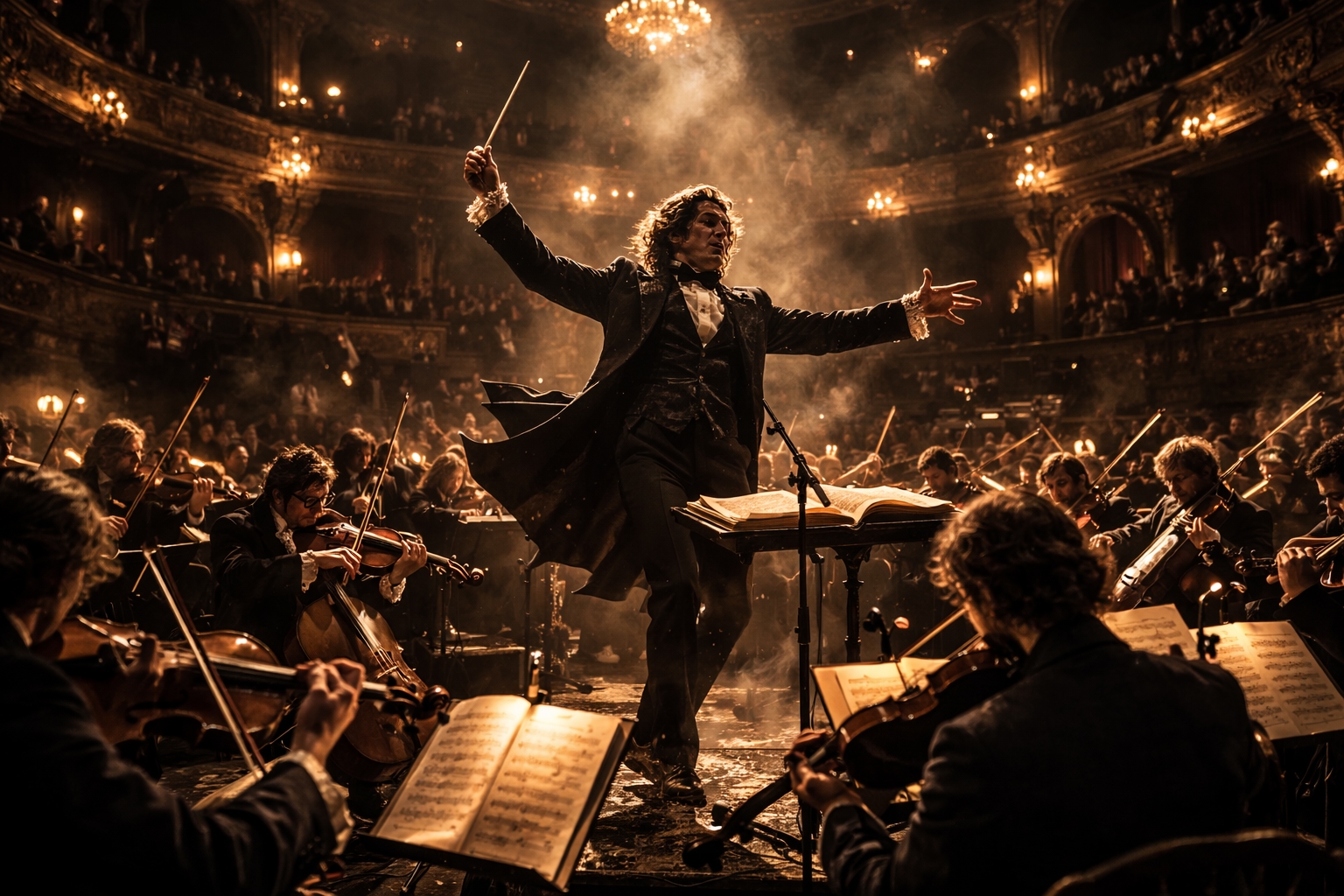 Berlioz was twenty-six years old. He had assembled an orchestra of unprecedented size—somewhere around ninety musicians, with massive string sections and a battery of percussion that Parisian audiences had never encountered in a concert hall. The venue was the Salle du Conservatoire. The program included other works, but everyone in the room knew what they’d come for. Berlioz had distributed a written program describing the symphony’s narrative: a young artist, consumed by obsessive love, poisons himself with opium. What follows are five movements of hallucination—a ballroom waltz that keeps fracturing, a pastoral scene shattered by distant thunder, a march to his own execution, and a witches’ sabbath where the beloved’s melody is grotesquely transformed.
That program was revolutionary in itself. Symphonies weren’t supposed to tell stories. They were abstract, formal, structured by musical logic rather than narrative. Berlioz handed the audience a plot and dared them to hear it. He was essentially inventing program music—the idea that an orchestra could narrate an emotional journey as vividly as a novel or a play.
The idée fixe was the structural innovation that made it work—a single melody representing the beloved that appears in every movement, transformed each time by the artist’s shifting mental state. In the first movement, it’s tender and yearning. By the finale, it’s a vulgar dance at a witches’ sabbath, the beautiful melody twisted into something mocking and grotesque. The beloved hasn’t changed. The artist’s perception has. That’s a psychological insight disguised as a musical technique, and in 1830 it was unlike anything anyone had heard.
The audience that night included Franz Liszt, who was so electrified that he sought Berlioz out immediately after the concert and became a lifelong champion. The young Frédéric Chopin was likely present. Victor Hugo, Alexandre Dumas, and much of Paris’s artistic elite packed the hall. The critical establishment was less enthusiastic—some dismissed the work as noise, as the ravings of a talented madman who needed discipline rather than a stage. The debate over the Symphonie Fantastique split the Parisian musical world in two, and in many ways that split has never fully healed. Berlioz remains one of the most polarizing composers in the classical canon.
What strikes me most about the premiere, and what I tried to capture in the novel, is the courage it required. Berlioz put his private obsession on a public stage. The symphony’s subject was an open secret—everyone knew the beloved of the idée fixe was the Irish actress Harriet Smithson, who had captivated Berlioz from the audience of her Shakespeare performances. He was confessing, through ninety musicians, that his love had driven him to the edge of madness. And then he conducted it himself, standing in front of a thousand people, turning his heartbreak into sound.
In The Year of Shadows, that night is the novel’s climax—everything the characters have lived through converges in the concert hall. But the real event needed no embellishment. A twenty-six-year-old composer stood before Paris and said: this is what obsession sounds like. Nearly two hundred years later, we’re still listening.
~ Liam